
|
Task list - - Commands - - SYSINF (System parameters)
SYSINF The SYSINF command is available as from BS2000 V10.0, and displays the global system parameters in the mask shown below.
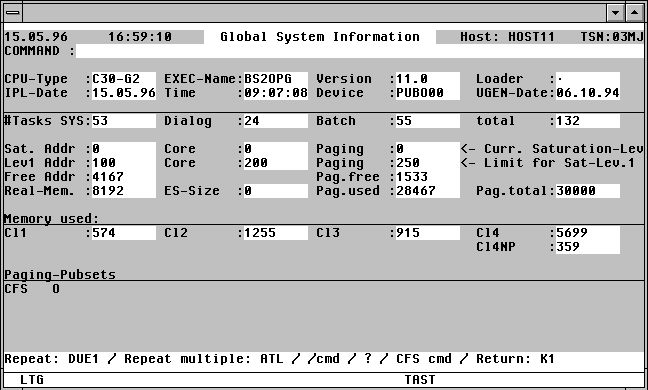

With a mouseclick you get a describtion of the screen item.
For a description of the individual values, see page .
Commands: The following entries, amongst others, are possible from the Command field of the screen:
ATL [INT=sec] Asynchronous automatic update of the screen information in the specified time period.
NP* Update the list.
POS xxx=yyy Position the window at a specific list entry, particulary useful after NP* (xxx = field name from the title line, yyy = required field contents)
S srch [=INSRT -] Search for a specific entry in the list, and hide it, if required
SORT xxx Sort the list on any field name from the title line
n/OCn/CCn/DCn/CD
CFS commands for controlling Connections. For further information, see page .
HELGA Call HELGA as a subprogram. Return by entering the HELGA command END.
EXPL file Export the list to a file
HC file /NHC Capture the screen to a hardcopy file.
A summary of the global system parameters is displayed in the SYSINF mask. The individual fields are described below.
CPU-Type: CPU type.
EXEC-Name: Name of the BS2000 Exec. This name is defined in the GEN BS2000,NAME= statement in UGEN.
Version: BS2000 version number.
Loader: Loader.
IPL-Date: Date of the last IPL.
Time: Time of the last IPL.
Device: Current IPL device.
UGEN-Date: Date on which the loaded Exec was generated.
#Tasks SYS: Number of system tasks.
#Dialog: Number of dialog tasks.
#Batch: Number of batch tasks.
#total: Total number of tasks, including system tasks.
Sat. Addr: Current Address Space Saturation Level.
Core: Current memory Saturation Level.
Paging: Current Paging Saturation Level.
Lev1 Addr: Address Space Saturation Level 1 limit.
Core: Memory Saturation Level 1 limit.
Paging: Paging Saturation Level 1 limit.
Free Addr: Number of free Page Frames (4k pages) in the address space of the operating system. This figure is calculated as follws:
Free = max. sys. adress space 32768 - Lev1 Addr - CL2 - CL3 - CL4.
Pag.total: Total number of Page Frames (4k pages) in the Paging Area.
Pag.used: Total number of 4k pages currently used from the Paging Area.
Pag.free: Total number of 4k pages currently free in the Paging Area.
Real-Mem.: Total number of Page Frames (4k pages) of memory (1MB = 256 Page Frames).
ES-Size: Number of Page Frames in Extended/Global Storage.
Pages Cl1: Number of Page Frames (4k pages) used in Class 1 memory (1MB = 256 Page Frames).
Cl2: Number of Page Frames (4k pages) used in Class 2 memory.
Cl3: Number of Page Frames (4k pages) used in Class 3 memory.
Cl4: Number of Page Frames (4k pages) used in Class 4 memory (pageable).
Cl4NP: Number of Page Frames (4k pages) used in Class 4 memory (non-pageable).
Paging-Pubsets: The PVS-ID's for the devices on which the Paging Area is located will be displayed.
SHRBASE: Base address of the Share area under the 16MB limit. Modules can be loaded into the Share area by means of the SHARE command. This is also the area reserved for CL4 subsystems in NXS memory (DOMAIN=LOW).
SHRSIZE: Size of the Share area in megabytes. The size is determined by the difference between the Share base and the 16MB limit.
SYSBASE: Address from which the operating system is loaded.
SYSSIZE: Maximum memory size for the operating system, in megabytes.
USXBASE: User XS Base. Start address from which the XS memory for user tasks begins.
USXSIZE: User XS Size. Maximum size of the XS area for user tasks. This value can be restricted for each user in the respective Join entry.
VASMAX: Maximum Virtual Address Space. The size of the address space used by system or user tasks will be displayed here. SYSSIZE can be a maximum of the difference between VASMAX and SYSBASE. The size of the system-internal address translation table can be restricted by reducing VASMAX.
VASSIZE: Size of the maximum addressable memory (NXS + XS, system or User), in megabytes.